The mining industry is the backbone of modern civilization, providing the essential raw materials required for everything from infrastructure to advanced technology. However, a mine is not a permanent fixture; it follows a very specific and structured progression known as the Life Cycle of a Mine. This cycle is a multi-decade journey that requires meticulous planning, massive capital investment, and a deep commitment to environmental stewardship. For professionals in the field, understanding these stages is vital for optimizing resources and ensuring long-term profitability.
Strategic planning throughout the Life Cycle of a Mine allows companies to mitigate risks and adapt to market fluctuations. From the first geological survey to the final blade of grass planted during reclamation, every step must be executed with precision. In the modern era, this cycle is also heavily influenced by ESG (Environmental, Social, and Governance) standards, which dictate how a mine interacts with its surroundings and the local community. This article is from alpha grinding media and talks about the Life Cycle of a Mine.
The Strategic Importance of the Life Cycle of a Mine
Viewing a mining project as a finite process is essential for financial modeling and operational management. Each stage of the Life Cycle of a Mine presents unique challenges and opportunities. While the exploration phase is high-risk and high-reward, the production phase focuses on cost-per-ton optimization. By recognizing where a project stands in this cycle, managers can make informed decisions regarding equipment procurement and labor allocation.
Furthermore, a holistic view of the Life Cycle of a Mine ensures that closure costs are factored into the initial feasibility studies. This prevents “stranded assets” and ensures that the company remains compliant with international environmental laws. Modern mining is no longer just about extraction; it is about responsible lifecycle management from cradle to grave.
Phase 1: Exploration and Prospecting
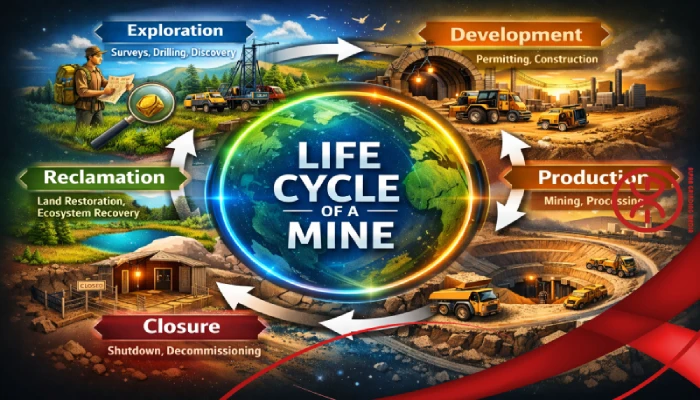
The first phase of the Life Cycle of a Mine is exploration. This is the stage where geologists search for mineral deposits in quantities that could be economically viable. It begins with large-scale surveys, often using satellite imagery and aerial geophysical sensors to detect anomalies in the Earth’s crust. If a promising site is identified, the team moves to ground-level prospecting and geochemical sampling.
Once a potential ore body is found, the process shifts to “diamond drilling” to collect core samples. These samples are analyzed in laboratories to determine the grade and thickness of the mineral deposit. This data forms the basis of the Resource Estimation. Only a tiny fraction of explored sites actually progress to the next stage of the Life Cycle of a Mine, making this phase the most speculative and risky for investors.

Phase 2: Design and Development
After a resource is confirmed, the project enters the Design and Development phase. This is arguably the most complex part of the Life Cycle of a Mine. During this time, engineers conduct a Feasibility Study to determine the most efficient mining method—whether it be open-pit, underground, or a hybrid approach. This study considers the depth of the ore, the stability of the surrounding rock, and the proximity to water and power sources.
Simultaneously, the company must secure the “Social License to Operate.” This involves obtaining environmental permits and negotiating with local governments and indigenous communities. Infrastructure construction also begins here. Building roads, ventilation shafts, and tailings dams are all essential parts of developing the site. At this stage, choosing the right partners and suppliers is crucial for setting the foundation for the upcoming production years.
Phase 3: Operations and Production
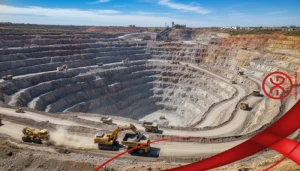
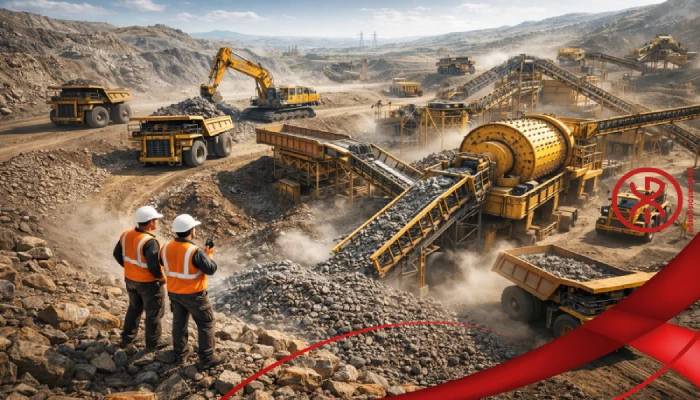
The Operations phase is where the actual value is extracted and is the longest stage in the Life Cycle of a Mine. Ore is excavated, transported to the surface, and sent to a processing plant. In the plant, the ore undergoes comminution—a process of crushing and grinding—to release the valuable minerals from the waste rock (gangue).
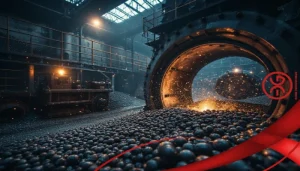
Efficiency during production is the primary driver of a mine’s success. The grinding circuit is often the most energy-intensive part of the entire operation. This is where the quality of consumables becomes a game-changer. For instance, using premium solutions from Alpha Grinding Media can significantly improve throughput and reduce wear rates in ball mills. High-performance grinding media ensure that the particle size distribution is optimal for downstream flotation or leaching processes.
By integrating top-tier products from Alpha Grinding Media, mines can lower their energy consumption and maintenance downtime. Given that the production stage of the Life Cycle of a Mine can last anywhere from 10 to 50 years, even small improvements in grinding efficiency result in millions of dollars in savings over time.
Phase 4: Closure and Decommissioning
Every mine eventually reaches a point where the cost of extraction exceeds the value of the minerals being recovered. When the ore body is exhausted, the Life Cycle of a Mine moves into the closure phase. This is a highly regulated process that involves shutting down operations and dismantling infrastructure.
During decommissioning, all machinery is removed, and hazardous materials are safely disposed of. Ventilation fans are turned off, and mine shafts are sealed to prevent unauthorized access or environmental leakage. It is a transition period where the focus shifts from profitability to safety and environmental stabilization. Effective planning in the earlier stages of the Life Cycle of a Mine ensures that this transition is smooth and does not lead to legal or financial liabilities.
Phase 5: Reclamation and Post-Closure
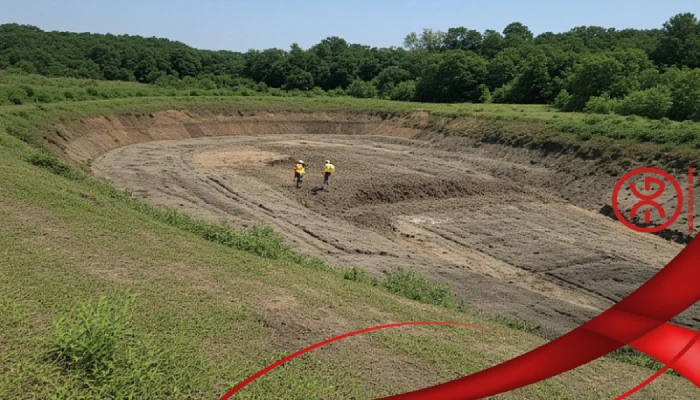
The final stage of the Life Cycle of a Mine is reclamation. The goal here is to return the land to a stable, productive state that resembles its original environment or is suitable for a new use, such as a park or a solar farm. This involves backfilling open pits, stabilizing tailing dams, and re-seeding the area with native vegetation.
Water quality monitoring is a critical component of post-closure. Mining companies must ensure that runoff from the reclaimed site does not contaminate local watersheds. This phase can last for several years or even decades after the mine has stopped producing. A successful reclamation marks the official end of the Life Cycle of a Mine, demonstrating the company’s commitment to sustainable development and environmental integrity.
Economic and Environmental Challenges
Managing the Life Cycle of a Mine is not without its hurdles. Market volatility can turn a profitable project into a liability overnight. If commodity prices drop significantly during the development phase, a company might be forced to put the project on “care and maintenance.” Additionally, stricter environmental regulations are constantly being introduced, requiring mines to adapt their waste management and carbon footprint strategies.
Technological innovation is the primary tool used to combat these challenges. From automated haulage trucks to advanced sensors in the milling circuit, technology is extending the productive Life Cycle of a Mine by making it possible to extract lower-grade ores profitably. Consistency in the supply chain, such as relying on Alpha Grinding Media for critical grinding components, allows operators to maintain steady production even in fluctuating markets.
Conclusion
The Life Cycle of a Mine is a complex, multi-stage process that requires a delicate balance of engineering, finance, and environmental science. From the initial spark of discovery in the exploration phase to the final replanting of the landscape in reclamation, each step is interconnected. By understanding and optimizing every phase, mining professionals can ensure that their operations are not only profitable but also sustainable for future generations.
Success in the modern mining industry depends on the quality of both the strategy and the materials used. Whether it is a new exploration project or a mature operation looking to optimize its mill, respecting the Life Cycle of a Mine is the only way to achieve true excellence in the field.
Frequently Asked Questions
1. How long does the average Life Cycle of a Mine last?
The duration varies greatly depending on the size of the deposit and market demand. Small mines may only operate for 5 to 10 years, while massive Tier-1 assets can have a Life Cycle of a Mine that spans over half a century.
2. Which phase of the cycle is the most expensive?
The Production phase generally has the highest total expenditure due to labor, energy, and consumable costs. However, the Design and Development phase requires the highest upfront capital investment (CAPEX) before any revenue is generated.
3. Why is grinding media so important in the production phase?
In the production stage of the Life Cycle of a Mine, grinding is essential for mineral liberation. High-quality media, like those from Alpha Grinding Media, reduce energy waste and ensure the ore is ground to the exact specification needed for chemical processing.
4. Can a mine be reopened after the closure phase?
Yes. If new technology makes it possible to process low-grade ore or if market prices rise significantly, a mine can be brought out of “care and maintenance” or even reopened after initial closure, effectively restarting parts of the Life Cycle of a Mine.